
| 3rd TRANSNATIONAL MEETING |
MINUTES OF THE MEETING FOR DOWNLOAD:  58KB MS-WORD 6.0 DOCUMENT | EUROPEAN INITIATIVE «EMPLOYMENT» AXIS HORIZON - DISADVANTAGED Transnational programme: "LINKS" Greek National programme: "WORKING - IMPROVING" 3rd Transnational Meeting Naoussa - Emathia, 7-9 November, 1996 - MINUTES OF THE MEETING - Organization responsible for the transnational cooperation: KEK-MIT - Vocational Training Center TABLE OF CONTENTS:
A. PARTICIPATING ORGANIZATIONS A.1. TRANSNATIONAL PARTNERS IRELAND · Mrs. Rose Anderson (In charge of the Irish delegation of LINKS - INFORMATION CAPITAL 2000) · Mr. Paul McCulloch (From the Parents-Guardians Association - CARE) · Mr. Mike McInerney (NAAS Library), and · Miss. Lise Coic (Kildare County Library) ITALY - ORGANIZATION MIZANSCENA · Mrs. Fabiola de Toffol · Mr. Antonio Venti IRELAND - EVALUATOR · Mr. Sean O'Siochru (NEXUS Research)  A.2. NATIONAL PARTNERS PREFECTURE GOVERNMENT OF EMATHIA · Mr. Andreas Vlazakis, Prefect · Mr. Lazaros Temas, Vice-Prefect · Mrs. Chrysoula Athanassopoulou · Mr. Vassilis Tsiliopoulos · Mrs. Aggeliki Christeli DEVELOPMENTAL COMPANY OF EMATHIA · Mr. Tassos Hajisavas, President · Mrs. Natasha Sollakoglou · Mrs. Andriana Koufaki GENERAL SECRETARIAT FOR YOUTH · Mr. Tsinos (Director of the Community programmes) · Mr. Vassilas (In charge of the programme WORKING-IMPROVING) MUNICIPALITY OF VERIA MUNICIPALITY OF NAOUSSA · Mr. Giannakouris, Deputy Mayor MUNICIPALITY OF MELIKI MUNICIPALITY OF PLATI PARENTS OF PSN ASSOCIATION OF EMATHIA COUNTY KEK MIT Vocational Training Centre · Mr. Nikolaos Krimnianiotis · Mrs. Maria Krimnianioti · Mrs. Kondylia Hajiyianni · Mr. Andreas Xanthos KEK AMY · Mr. Orestis Christidis B. DISCUSSION MAIN TOPICS 1. Presentation of the actions of the Greek programme 2. Presentation of the actions of the Irish programme 3. Presentation of the actions of the Italian programme 4. Presentation of methodology and tele-education system MIT-COM, by KEK-MIT, transfer of experience relating to the development of educational material using multimedia technologies. The technical platform of networks, linking methods, use of Internet to provide educational services, linking of the tele-education systems with Web 5. Search for methods of establishing communication among partners via Internet, Forum for the development of investigation into matters relating to the PSN (Person with Special Needs). Determination of the main points of the presentation of the transnational programme LINKS on the Web 6. Conclusions, Follow up actions and meetings 7. Evaluation B.1. Presentation of the actions of the Greek programme 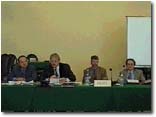 After the salutation by the Prefect of Emathia, the presentation of the actions in the Greek programme LINKS (WORKING-IMPROVING) commenced with keynote speaker Vice-Prefect Mr. Lazaros Temas, who, after a general review on the European Union policy, referred to the actions that were completed or are in progress and regard the Greek part of the programme LINKS. After the salutation by the Prefect of Emathia, the presentation of the actions in the Greek programme LINKS (WORKING-IMPROVING) commenced with keynote speaker Vice-Prefect Mr. Lazaros Temas, who, after a general review on the European Union policy, referred to the actions that were completed or are in progress and regard the Greek part of the programme LINKS.In particular: The Developmental Co. of Emathia (AN.IMA), since last July has started a survey at Prefecture level for the identification of the P.S.N. of the region and their needs. This survey has moved forward and it is already at the stage, where the results are evaluated. Parallel to that, the remaining actions of Measure 1 have started, i.e.: · The application study for professional packages (mainly software packages and tools) using new technology · The feasibility study for the establishment and operation of the Institute for planning Research and Consultation · The economic-technical study on the establishment of an Occupational agency and its operation as a Commercial Network to promote the products of the P.S.N. Next, there was a presentation of information from the survey for the registration of the P.S.N in the Prefecture of Emathia. 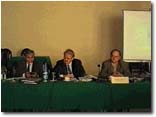 Afterwards, Mr. Krimnianiotis took the floor and he referred to Measure II. In the context of this measure there was training of 10 trainees in the subject "Consultants for Career Planning and the promotion of the commercial network of the P.S.N." which will be working after that as trainers-encouraging the P.S.N. The training was completed successfully and at this moment is at the stage of practical exercise and of the evaluation of the results. Afterwards, Mr. Krimnianiotis took the floor and he referred to Measure II. In the context of this measure there was training of 10 trainees in the subject "Consultants for Career Planning and the promotion of the commercial network of the P.S.N." which will be working after that as trainers-encouraging the P.S.N. The training was completed successfully and at this moment is at the stage of practical exercise and of the evaluation of the results.Due to the delay in the commencment of the transnational meetings, but also because of the fact that Measure III practically cannot begin without the completion of the surveys of Measure I, there is a general delay, for which the Prefecture Government shall take the necessary actions, so that the programme is completed at the scheduled time, i.e. the end of 1997. Also, there is considerable delays with the funding, since there hasn"t been any payment even of the advance funding (37.5%) for the actions already started. B.2. Presentation of the actions of the Irish programme 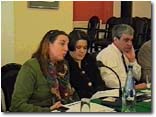 Mrs Rose Anderson presented the aims and the basic axes of the Irish National programme INFORMATION CAPITAL 2000. Mrs Rose Anderson presented the aims and the basic axes of the Irish National programme INFORMATION CAPITAL 2000.The basic goal of that programme is to determine employment strategies, in order to establish an environment of "supported" work for the People with Special Needs. The participants in the programme have as their objective the organization and the creation of a series of courses (curriculum) -suitable training packages- for the personnel of the organizations, the parents and the guardians, as well as for every one who is interested, as to how to use on-line communication systems in order to be in position in turn to organize basic educational cycles addressed to the P.S.N, the unemployed, as well as to people with adaptation problems. These courses refer to information technology and communication issues. The objects of the programme include:
With reference to funding, no particular problem has been encountered and the programme continues its regular course. Mr. Paul McCulloch presented the methodology behind the programme and he went on to point out the issues that must be noticed during the adaptation of technology to the needs of the people. He also presented the way the educational seminars are organized, he gave examples of training (What is Internet, what kind of service does it offer, ea.) and in the end he described the application of Task Analysis as a teaching- training tool. Furthermore, he presented a video which was an account of the Irish experience in the search to find the proper employment opportunities and in the education and the support of the PSN in order for them to be incorporated into the work environment. Finally, Mr. Mike McInerney presented the goals of the actions he is responsible for in the library: adaptation of the computer systems so that these can be used by the PSN in the library environment for learning purposes or to access information. This action also provides for the use of networks and in particular of Internet, in order to improve the access of the PSN in the library. B.3. Presentation on the actions of the Italian programme 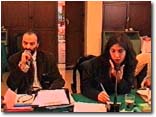 Mrs Fabiola de Toffol described the particular problems of the group of trainees, who mainly suffer from psychiatric ailments. She referred to the advantages in the use of computers (by these people) as tools for communication and contact with the wider environment. Mrs Fabiola de Toffol described the particular problems of the group of trainees, who mainly suffer from psychiatric ailments. She referred to the advantages in the use of computers (by these people) as tools for communication and contact with the wider environment.The programme develops into two parallel levels: The psychiatrical and the technological. The vocational training in particular-multimedia communication training and utilization of the equipment / tools-is developed with the cooperation and with the support of the therapists. This means that the students attend the training monitored at the same time by their therapists, which however, do not intervent in the process. The linking between the therapeutic and the technical level, shall be the subject of the work of collaboration of the people responsible for the Technological and Psychiatric field (Antonio Venti, Maurizzio Veneci). Next, there was a presentation of three video, where people cooperating with Mizanscena in the technical field were being interviewed. The pre-training is scheduled to begin in the middle of November. Regarding the information-communication technology, they are in contact with the company "Archimides" (a Software House), which is developing voice-recognition programmes. The other national partner of the programme, PromoVideo is starting communication between the partners mainly aimed at the creation of network (at National level), which shall be involved with the problems of the PSN. The network will contain information concerning labor issues for the PSN. In the field of video - documentation, at this moment the meetings between the partners are taped in order to prepare an interim report, which will be available also for the transnational partners. Regarding the funding, the Italian Labor Ministry has not given enough money, given the fact that the most expensive part of the programme has started and the problem at the moment is significant. Because of that, the part of the programme regarding vocational training cannot begin since it requires the purchase of quite expensive equipment. In the case that the Ministry gives enough money until the end of November, the training will begin in January of 1997. Finally, Mrs de Toffol mentioned the matter of coordination of the transnational partnership according to the time schedules of the national programme. Possible end of the Italian programme is the end of 1998. B.4. Presentation of the methodology and a system of tele-education (distance learning), MIT-COM by KEK-MIT, transfer of experience related with the development of educational material using multimedia technologies. Technical platform of networks, methods of linking, use of the Internet to provide educational services, linking of the tele-education systems with the Web. The purpose of the presentation was to illustrate the way the tele-education procedures are implemented with the use of existing infrastructure (Computers, networks, telecommunication). Distance learning (tele-education) is a type of education, where the teacher and the students are physically separated. This type is continuously developed, using every time the current technology available. The current generation of distance learning is based on the concept of the electronic classroom. Thus, through the computers we are trying to simulate the functions of an educational organization. Therefore, we transfer these "natural" functions of the organization in question (classrooms, discussion areas, library ea.) into procedures with the help of computers and networks. Why is distance learning used:
Based on the above principles we developed a tele-education system called Mit-Com, which combines database, multimedia and network (Internet) technologies, in order to achieve our objective, which is the simulation of an actual classroom. At this point, it must be pointed out that the particular distance learning system does not have specialized authoring tools, or features requiring complex and time-consuming installation to the users (teachers and students). Mit-Com implements the general context and defines the rules of communication and cooperation between the users, leaving them open to choose any tools they wish during the process of study. Thus they will be able to use a word processor, a picture processing programme, they will also be able to use the multimedia capabilities (sound and video) and to incorporate the result in a document-message with specific clients/receivers. The basis of this system as well as the determining factor is the human being. For every person participating in the process we define a role. The roles supported by the system are: Managers- Coordinators (of the educational process), Authors of the educational material and Students. The thing that these people have in common is the educational cycle. Thus, the set of the people incorporated under the same educational cycle, makes up the electronic classroom. Every person, depending on their role, can handle different tools. The whole tele-education process is based on documents. Every document constitutes an environment in which we can "attach" and we can tranfer through the network, our messages and our educational material. The educational material consists of text, pictures, sound and video. Any type of "digital" information may be attached on the documents and transferred through the network. The teacher, once he has organised his course into units and has sent to the students the schedule, can begin his lecture (within a day) attaching a document-message, through which he explains the subject of the lesson, provides explanation and creates links with the electronic books available. The system based on the Windows NT (Server) and Windows 95 on the part of the Client (user-student-trainee or instructor-teacher). As a developmental platform we have chosen to use Lotus Notes. Every user has their own PC, an installation of Lotus Notes Client and an access license to the nearest Internet provider. The cost of this license (in today"s prices in Greece) is not more than $210/ year with capability of 24-hour connection. With this package every user will be able to be attached with the Tele-education Server. The reasons that made us decide on the utilization of Lotus Notes as our main platform of development of Mit-COM, are the following:
Every user interested in participating in an electronic educational course must get in touch with the KEK-MIT (Vocational Training Center), either by phone or via e-mail and, once they go through the provisional evaluation procedure, they shall become part of a group. From the moment the classes/groups are set-up and the participants are established there will follow a short educational cycle (6-12 hours), where the students shall meet the instructor, shall be informed on the training to follow and shall learn to use the distance learning system in practice. Finally, every student shall receive a package comprising the necessary printed materials, information on the use of the environment and the respective software (electronic books in CD form and Lotus Notes Client) for installation in their Personal Computer (PC). In the case that a student does not have access to Internet, the KEK-MIT shall provide them with an access account along with necessary software and if necessary it shall proceed with the appropriate ""adjustments"" in the student"s PC. From that point on, the KEK-MIT ensures for every student a personal access account in the in the MIT"s Server, the capability of accessing the Forum and the Job Club, as well as the capability of creating their own personal page. The student shall work at his/her location studying the available material, shall state his/her questions and any explanations he/she needs and he/she shall enter them automatically in the Server at least twice a day (in the morning and in the afternoon) by connecting through Internet. During the connection, he/she shall also receive any new material that his/her instructor may have for him/her. Following this, was a presentation of the electronic books developed up to the moment by KEK- M.I.T. and there was a reference on the current status of the Internet in Greece. B.5. Search for ways of establishing communication through Internet among the partners, Forum for the development of concerns on matters relating ot the PSN, Determination of the main points of the presentation of the transnational programme LINKS on the Web. There was a presentation by KEK - M.I.T. of a plan for a Web site as well as of a Discussion area through which the partners shall be able to communicate. Through this area the participants - users are enabled to create new topics for discussion, to answer-comment on existing issues, or to answer back to some view which has been recorded. There will be two areas for discussion, one public (accessible by any one) and one private, which shall be available only to the partners of the programme. We can attach to the system (Discussion) any other form of files (pictures, text, sound) or any page in the HTML format. Having, thus, these capabilities we can exchange files, create links with other pages or other areas of the network and in general, we can utilize the system as a common area of the transnational partnership. Also, ways of direct communication through Internet (Cool Talk) were presented. After the presentations, a sub-group was composed consisting of Mr. McCulloch, Mr. Venti and Mr. Xanthos, which was occupied with the determination of the general context for the follow up work of the transnational partnership. The sub-group proposed to the assembly of the transnational partners workshop the following:  To develop an common area for the partners in the Internet (Web site), which shall comprise: To develop an common area for the partners in the Internet (Web site), which shall comprise:
It was also proposed to:
We now summarize the conclusions of the discussion in the Workshop. B.6. Conclusions, Actions to follow and follow up meetings 1. Planning of the framework of a Web site for the LINKS programme, which shall contain the topic units as these are mentioned in the proposal of the sub-group, as well as the explanation given afterwards in this unit (B.6). Each partner from his end will have to collect information and update the units that will be on the Web site. 2. Creation of a common methodology. It was decided to make up a page, which shall lead to distance learning methodologies, that every agency uses. The participation in this page is not compulsory by all partners. However, whoever is able to suggest any topic, it would be good to say so, with possible links to his source, so that the rest of the partners can be informed on issues involving distance learning. We could add information on the adaptation of the equipment to the needs of the PSN. Also, we could define the rules as to how we envisage the ideal model of distance learning so that this information can be used as a point of evaluation and as a basis for future programmes and partnerships. Having the above in mind, we could say that in order for us to create the conditions for ideal distance learning - in the present stage - we must be involved in three partial elements-units. The Creative (video, mainly Italy), the Logistics, management, technical platform, education control, educational material (Greece) and the Adaptation of the equipment (Italy). Therefore, we agree to make up the three different units and in the months to follow, to create a Forum through which we shall exchange ideas, educational experience, building step-by-step the model of the ideal tele-education. In the beginning of this page, there will be a general review - consideration regarding how we look upon the ideal tele-education. Next, we could mention special methodology adaptation so that we can easily approach different client bases (e.g. PSN, unemployed people, professionals ea.) without, of course mentioning any labels/titles such as (PSN or anything else), we simply leave the people open to choose the model that is best fitted for them. In the end of this page there will be links leading the reader to the pages where each partner presents their work (mainly at National level). In this unit we can also incorporate the creation of a self assessment (self-diagnosis / self-evaluation) package, which shall regulate the Software in such a way that it operates according to the capabilities and the needs of the user. For this package we suggest a simple plan of actions, which comprises the following points:
Regarding the first and second point, the responsibility lies with the Irish partners and as for the rest it iles with the Greek partners. It would be good, before the development starts to discuss in greater depth the second point (synthesis of the proper questions) with the rest of the partners. 3. The technical leg regarding the creation of the above Forum and pages will be the responsibility of KEK-M.I.T., making up the framework-platform, in order to get the collaboration - teleworking going, in a Virtual space (according to Rose). Until Christmas the platform of development of the common methodology must be prepared. The rest of the partners must send their comments by the end of January 1997. 4. We are going to hold a transnational meeting through Internet, around the middle of Febrouary 1997. It will be held with Greece being the host at the KEK-MIT Server. An agenda will have to be formulated to determine the response time of the partners. In the mean time we"ll have the chance to test/check the procedure in practice. The official language for the meeting will be Engilsh. 5. Regarding the next transnational meeting we set the location in Perugia, Italy and the time will be between the 10 to 13 April, 1997. This is the first weekend after the Orthodox Easter. 6. The final meeting shall be conducted in September of 1997 at Emathia. One of the days of the meeting shall be an open meeting and the rest of the days shall be meeting of the partners only. 7. The comparative cost analysis for the implementation of tele-education in all three countries is undertaken by the Italians, who shall prepare the final report (taking into account the Italian situation as well as the information from the other countries (to be provided by the respective partners). The points that must be studied in this analysis, considering an educational cycle of one month, in an electronic classroom of 20 people, are: The required Hardware and Software, the network, the educational material (electronic form or conventional), the cost of training the trainers, the cost (wages) of the instructors, the cost of the other infrastructures as well as any other operational cost. The data must be given to the Italian partner by the middle of January (15 January, 1997) of next year. This analysis must be ready by February when it will be presented during the transnational meeting in the Internet. On the basis of the above the time-schedule of actions and meetings is set as follows:
The points that were identified to be in need of improvement are:
Closing the meeting, the chairman, Dr. Nikolaos Krimnianiotis, in a review of the 3rd transnational meeting he pointed out the following: "The objectives which had been set according to the programme of the transnational partnership, were generally achieved. One point not put for discussion, regarded the presentation and the start-up of a commercial network. Since, however, this action is based on Internet we can say that on the basis of the platform already developed as well as the works that are going to be carried out in the coming months, the commercial network shall be presented under the responsibility of the Greek partners, in the next meeting (Perugia, Italy). With reference to the rest of the topics that this transnational meeting had assumed we believe that it has been done more than it was provisioned. The meeting gave many positive elements and experience, despite the problems mostly at national level in relation to the funding, problems which do not allow many of us to work according to the goals and the time schedules we had initially set. In spite of all that, I believe that we have a point quite satisfactory and from now on each of us has a better understanding as to how they are going to proceed onward. According to the goals that we set the next meeting of the transnational partners shall be held on the Internet in February of 1997 and the one immediately following that, will be held in Perugia, Italy. In that meeting we believe that almost the entirety of our transnational obligations will have been completed". |